 The spotted coralroot (Corallorhiza maculata) is one of several unique North American orchids commonly called “coralroots” for the resemblance of their knobby underground rhizomes1Rhizomes are thickened stems that grow along or under the soil surface and bear shoots above and roots below. to undersea coral. The overall similarity and yet high degree of variation within and between species of coralroot renders taxonomic classification and, sometimes, identification difficult. Subtle to drastic differences in their color result from varying levels of pigments called anthocyanins within the orchids’ tissues. It is also influenced by the specific fungal host from which each derives its sustenance, as coralroots are mycoheterotrophs, parasitic plants that derive all or most of their sustenance from fungi in the soil rather than by manufacturing their own energy through photosynthesis. Through evolution, these opportunists have dispensed with unneeded leaves and chlorophyll, revealing the unusual colors they have retained.
Plant and Flower Characteristics
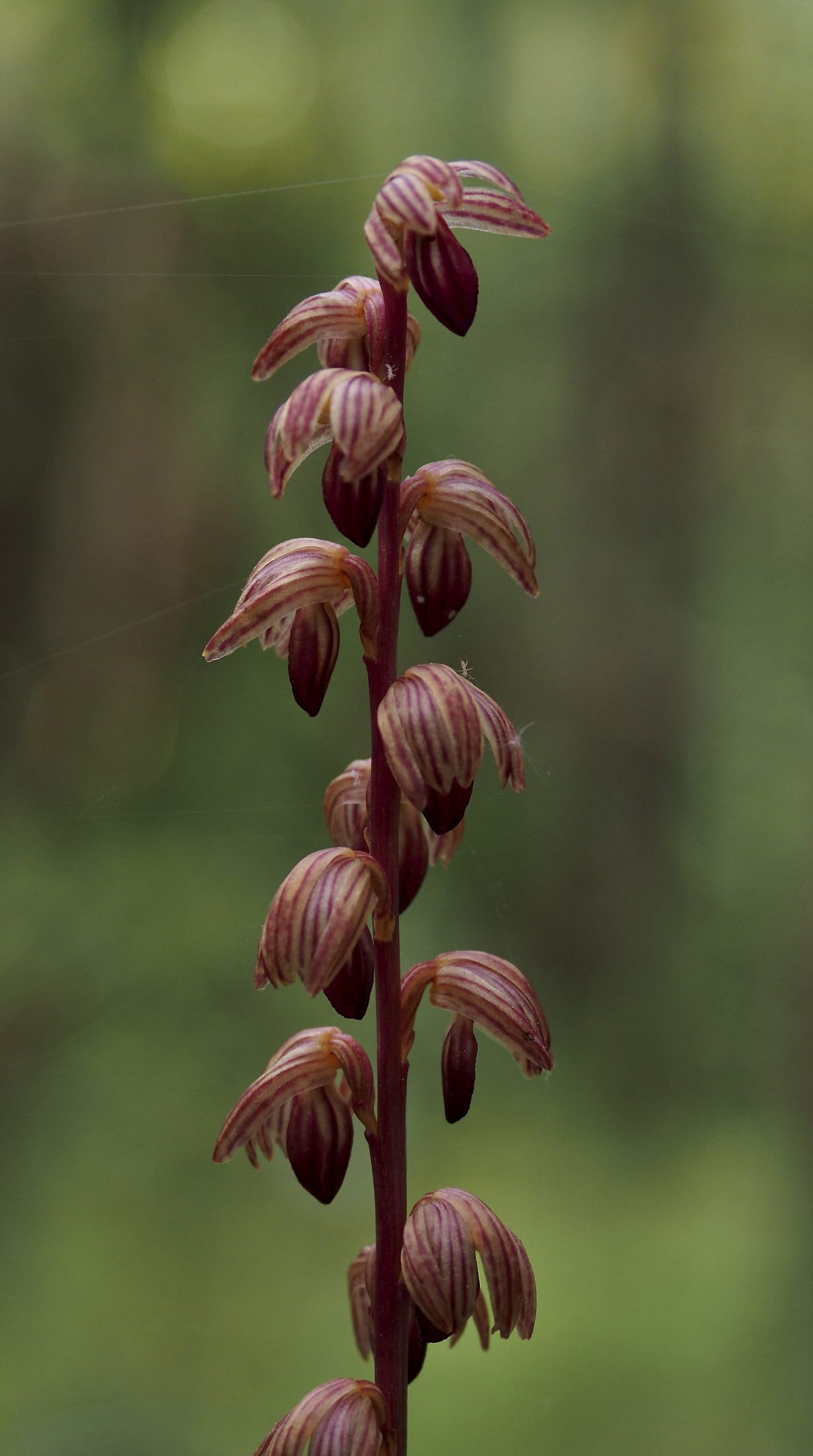
 An entire spotted coralroot is typically reddish or chestnut brown, but may vary with gradations of color through lemon yellow when few anthocyanins are present. The above-ground portion of the plant is merely a scape, or, a leafless floral stem. The remnants of what used to be leaves are reduced to sheaths that wrap the lower portion, sometimes in a contrasting color. Spotted coralroots bloom from mid-spring to late summer. The scapes occur singly or in clumps and can reach up to 23.0 inches / 60 cm in the form of a raceme, or, unbranched flower stalk bearing ten to forty individual flowers along its sides. Tiny, sometimes forked bracts2Bracts are leaves that occur within or just below a flower cluster and often differ in size, form, and sometimes color from ordinary leaves. may be visible below each flower where it attaches to the stem.
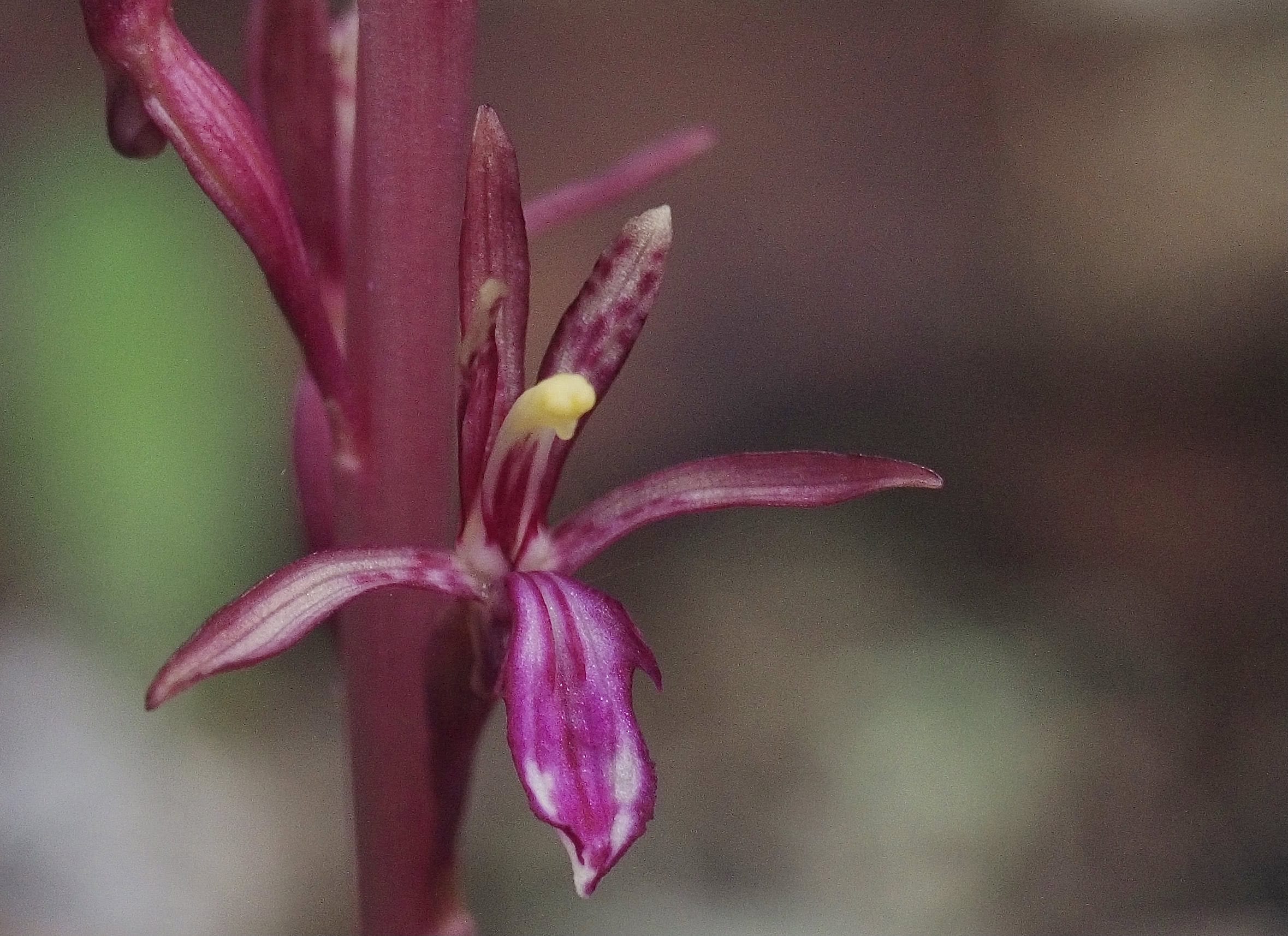
 The individual blooms display classic orchid form: the three sepals3Sepals are modified leaves that enclose a flower bud before it opens and are usually green. that enclose the bud before it opens fan above two lateral petals and one enlarged, lower petal called the labellum, or, lip. The lateral petals are typically held perpendicular to the labellum. The labellum has two small, pointed lobes that appear folded upward near its base. It is always white with irregular purple spots — except when it isn’t. Oddly, some varieties of the “spotted” coralroot lack its namesake spots. (See “Varieties” below.) When present, the spots sometimes extend onto the bases of the sepals and the other petals.
The spotted coralroot’s mode of pollination is similar to that of all its orchid kin. Jutting from the flower’s throat, the broad labellum serves as a landing pad for pollinators. As in other orchids, the stamens4A stamen is the male reproductive structure of a flower, consisting of an anther in which pollen is produced and usually a slender filament that attaches it to the flower. An individual flower typically has many stamens. and stigma5A stigma is the organ at the tip of a flower’s female reproductive structure that receives pollen. It is typically connected to the ovary by a style. These three parts together comprise the pistil. are fused into a central column that arches over the labellum. Beneath the column’s tip, little sacs of pollen called pollinia hang at the ready to hitch rides on the backs of unsuspecting  pollinators that brush against them as they blunder onto the labellum in search of nectar. When they move on to other coralroots, the process repeats in reverse, as the roving pollinators inadvertently deposit the sacs onto the undersides of other columns in other flowers. In the accompanying photo, three pollinia are visible under the tip of the column of the flower on the right.
The spotted coralroot is a perennial; however, an individual plant typically only blooms every few years. Not requiring light for sustenance, it remains entirely underground for years at a time until it has gathered enough energy from its fungal host to emerge above ground for reproduction. However, in a given year, many individuals in a population will bloom, ensuring a consistent seasonal presence.
Varieties
 While some botanists have attempted to name the many permutations of spotted coralroots, only three and sometimes four varieties are currently recognized. The key differentiators are the width of the labellum and the presence or absence of spots on it.
Var. occidentalis: The labellum of var. occidentalis, commonly called the western spotted coralroot, expands up to 1.50 times wider at its tip than at its base, often with a slight terminal notch in its frilled outer edge. It is always spotted. The bract at the base of each flower is clearly visible. Var. occidentalis blooms up to a month earlier than the very similar var. maculata. It is found across most of the species’ overall range in Canada and the U.S. In Western Washington, its range overlaps with those of var. maculata and var. ozettensis.
Var. maculata: The labellum of var. maculata, commonly called the spotted coralroot, is the narrowest of the varieties, with nearly parallel sides and a rounded or bluntly pointed tip usually lacking a notch. Ironically for a plant with the Latin word for “spotted” (maculata) appearing twice in its botanical name, its labellum may or may not be spotted. The minute bract at the base of each flower is difficult to observe without magnification. Var. maculata blooms up to four weeks later than var. occidentalis. It is found throughout the species’ full range in Canada and the U.S. In Western Washington, its range overlaps with those of var. occidentalis and var. ozettensis.
Var. ozettensis: The labellum of var. ozettensis, commonly called the Ozette coralroot, is intermediate in width between those of var. occidentalis and var. maculata (i.e., broadened, but usually less than 1.50 times wider at the tip than at the base), unnotched, and sometimes even pointed. It is always clear white with no spots, the white often extending into the sepals and lateral petals. The bracts are also a size middling those of var. occidentalis and var. maculata and may be visible to the naked eye. Var. ozettensis‘ very small range in southern British Columbia and northwestern Washington overlaps those of var. occidentalis and var. maculata. It is not recognized as a distinct variety by all authorities.
Var. mexicana: Var. mexicana is found only in Mexico and Guatemala at the extreme south of the species’ range. Its labellum can be as wide as that of var. occidentalis and is always spotted. The stem, sepals, and lateral petals are often pale with a greenish cast.
Fruit and Seeds
 The fruit of the spotted coralroot is a bloated, elliptical capsule that dangles from the scape, tipped with its spent flower that remains as a tuft on its lower end. This arrangement results from each flower’s inferior ovary6The ovary is the female organ at the base of a plant’s female reproductive structure that produces seed and typically becomes the fruit or other layer around it. Together with the stigma that receives pollen and is usually attached to the ovary by a style, it comprises the pistil. An ovary is inferior when it is positioned entirely below the point at which all floral components join. that is positioned below the sepals and petals and is so lengthy that it appears to be part of the blossom’s stem rather than its future fruit. Similar to the bloom that bore it, the capsule is the same color as the stem, typically fading to tan or pale yellow. Each capsule contains hundreds of fine seeds with elongated, chaff-like appendages that likely aid in dispersal by wind.
Range
 The spotted coralroot ranges from southern Alaska across all Canadian provinces, most of the contiguous United States except for the southern plains and Gulf Coast, and as far south as Guatemala. Look for it in shady, low to mid-elevation coniferous or mixed forest with sparse understory and anywhere from moist to dry conditions, as in the accompanying photo of typical Western Washington spotted coralroot habitat.
Similar Species
Although it resembles other coralroot species in parts of its broad range, all varieties of the spotted coralroot notably differ from others native to Western Washington. The striped coralroot (Corallorhiza striata) is, as its common and botanical names imply, uniformly striped on its petals and sepals (except for its palest forms), which are larger, wider, and more hooded in appearance, and is generally more burgundy or pink in color than the spotted coralroot’s brown or orange. The Pacific coralroot (Corallorhiza mertensiana) has wispier, elongated stems and flowers that are typically translucent shades of pink. Although these species’ overall ranges overlap, individual populations of different species (and even of different varieties with a species) typically do not, likely because each requires a specific fungal host that is unique to a given location.
Gallery
© 2026 Anthony Colburn. Images may not be used or reproduced in any form without express written consent.