The heart-leaf, or, lesser twayblade (Neottia cordata) is one of the surprises hidden in plain sight upon the forest floor. Like its exotic tropical cousins, it is every bit an orchid with long stems of many blooms in classic form . . . but for its diminutive size. A sharp eye (or nose!) is required to locate this Lilliputian wildflower amid the dappled woodland understory but once discovered, it often proves locally abundant in expansive colonies.
Blooms
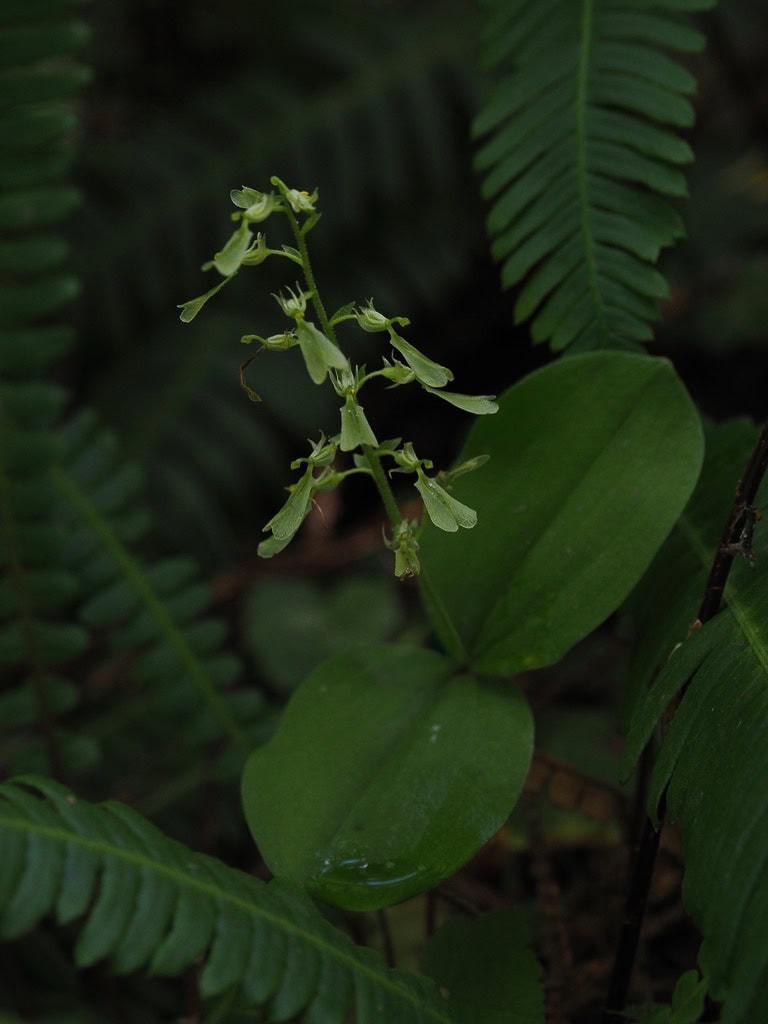
 The heart-leaf twayblade blooms from late spring to late summer in shades ranging from chartreuse through mauve and deep mahogany, often with individuals of varying colors occurring in the same population. Its most notable feature is its dramatically forked labellum, the lower petal in an orchid that is often uniquely shaped to facilitate pollinator interaction with the bloom. In the heart-leaf twayblade, the labellum is much longer than its other petals and the petal-like sepals1Sepals are modified leaves that enclose a flower bud before it opens and are usually green. that fan above it. The circular nectary at the center of the flower dispenses nectar down a groove in the labellum, forming an enticing runway for the tiny fungus gnats that are its primary pollinators. At the top of the labellum, two additional pointed lobes extend below the nectary, providing convenient “handholds” for the gnats to grasp as they drink and conveniently positioning them below the column that arches above. As in most orchids, the stamens2A stamen is the male reproductive structure of a flower, consisting of an anther in which pollen is produced and usually a slender filament that attaches it to the flower. An individual flower typically has many stamens. and stigma3A stigma is the organ at the tip of a flower’s female reproductive structure that receives pollen. It is typically connected to the ovary by a style. These three parts together comprise the pistil. are fused into a central column over the labellum. The heart-leaf twayblade’s column is armed with trigger hairs that release dollops of sticky pollen onto the backs of the gnats to carry on to the next flower unawares. After pollination, the flower’s inferior ovary4The ovary is the female organ at the base of a plant’s female reproductive structure that produces seed and typically becomes the fruit or other layer around it. Together with the stigma that receives pollen and is usually attached to the ovary by a style, it comprises the pistil. An ovary is inferior when it is positioned entirely below the point at which all floral components join. quickly swells into a globose seed capsule. The flower often remains unspent until the capsule splits along its parallel ribs to scatter microscopic seeds onto the wind.
Curiously, the blooms of the heart-leaf twayblade emit a foul odor humans have likened to the scent of spoiled seafood. While such fetor typically indicates pollination by insects attracted to carrion, botanists have observed no similar predilection in the fungus gnats and other pollinators drawn to the heart-leaf twayblade’s malodorous offering, rendering its purpose somewhat of a mystery.
Plant Features
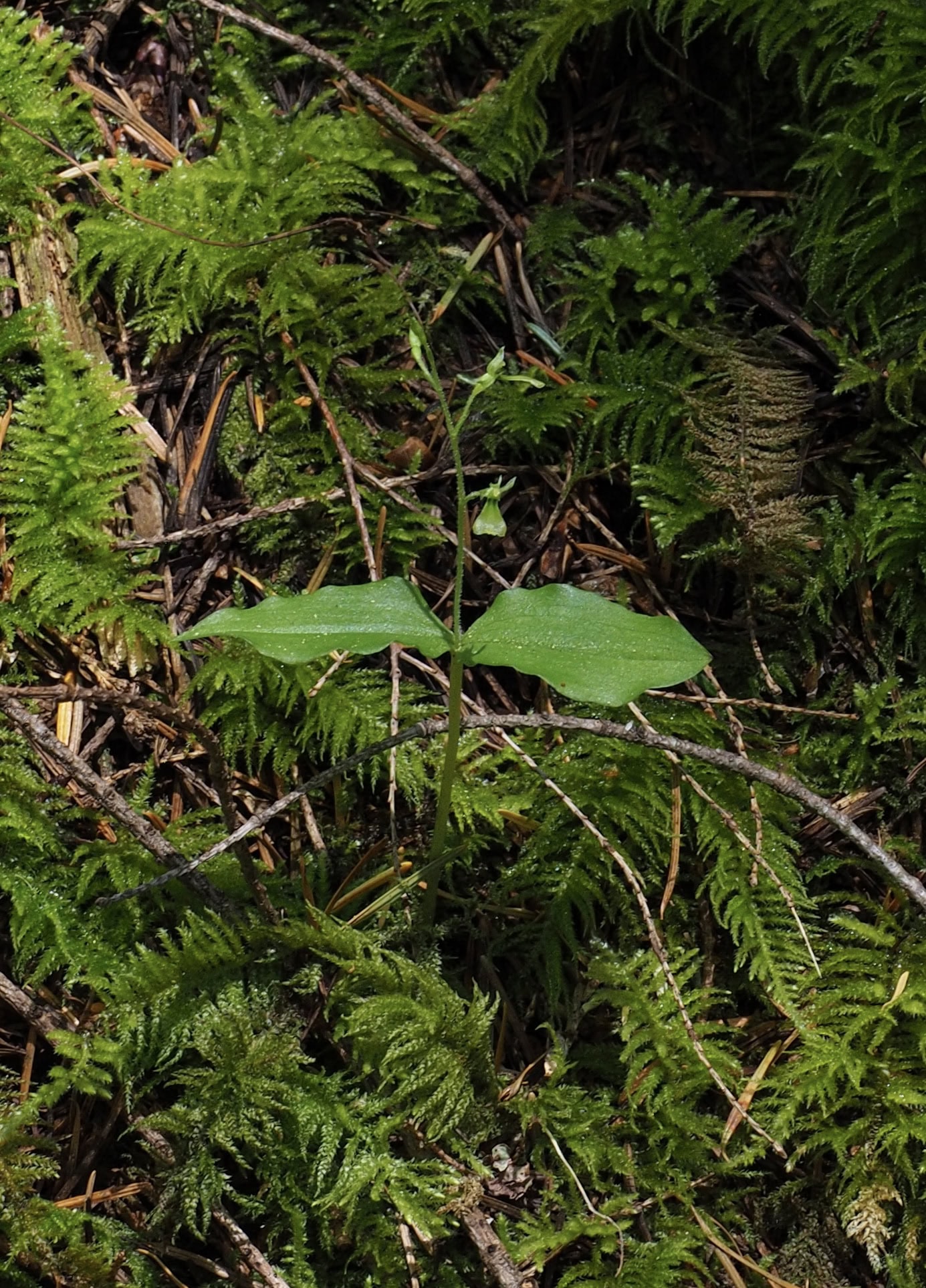
 Despite its small stature, the above-ground portion of the heart-leaf twayblade is more posy than plant, as at least the upper half of the stem consists of an unbranched flower cluster, or, raceme that bears up to twenty-five flowers. Below ground, this perennial’s trailing rhizomes5Rhizomes are thickened stems that grow along or under the soil surface and bear shoots above and roots below. may send up additional stems that eventually become separate plants. For this reason, a heart-leaf twayblade seldom appears alone and many in a given population are clones of one another. An individual plant typically has only one stem, but may bear as many as three, each clasped by a single pair of triangular or roughly heart-shaped leaves (hence the common name “twayblade”, or, “two leaf”). These leaves may have either straight or wavy edges. Rarely, a plant produces one or more additional leaves higher on the stem. The entire orchid can reach up to 13 inches/33 cm, although it is usually no more than half that height. The stems are slightly fuzzy and tend to match the color of the blooms. Upon close inspection, a small bract6Bracts are leaves that occur within or just below a flower cluster and often differ in size, form, and sometimes color from ordinary leaves. is visible on the stem at the base each bloom.
 Variations in the heart-leaf twayblade’s morphology7Morphology is the form or structure of a plant. across its broad range have led to attempts at classification of individuals with similar attributes into lower taxonomic ranks. However, these have proven problematic, as lack of consistency within and across such designations defies organization and may result from environmental factors rather than genetic diversity. In North America, where there is greater variation in the size and color of the heart-leaf twayblade, the west’s more petite version that produces flowers across the species’ color spectrum is sometimes considered a distinct variety, cordata, whereas its larger and typically green-flowered counterpart is sometimes classified as var. nephrophylla. However, var. nephrophylla becomes difficult to distinguish from var. cordata as it extends into the west. Specimens with additional leaves above the standard pair are sometimes considered unique forms of the species: f. trifolia if there is one additional leaf and f. tetraphylla if more than one. Given this fluidity in its morphology, Neottia cordata is sometimes characterized as a “species complex”, which recognizes variation between closely related organisms currently without authoritative delineation of specific taxa.
Similar Species
 Beyond its own minor inconsistencies, the heart-leaf twayblade has no similar species in North America. It is the “lesser” twayblade in comparison to the broad-leaved twayblade (Neottia convallarioides), a related species that shares its North American range and that has larger, oval leaves and distinct flowers lacking the forked labellum. (The northwestern twayblade, Neottia banksiana, has elongated, similarly paired leaves and shares the heart-leaf twayblade’s range in western North America, but otherwise looks much more similar to the broad-leaved twayblade.) The heart-leaf twayblade is also “lesser” to the large, wide-lipped, or, lily-lipped twayblade (Liparis liliifolia), an unrelated species native to northeastern North America that is dissimilar except for its paired, basal leaves. In Europe, the heart-leaf twayblade is similar to the common twayblade (Neottia ovata), which has larger, oval leaves that are paired at the base, rather than on the stem, thicker petals and sepals, and a much more yellowish hue to its stem and blooms.
Range
 The heart-leaf twayblade has a nearly circumboreal distribution encompassing northeast Russia and Japan, North America as far south as California, New Mexico, and North Carolina, and Europe as far south as the mountains near the Mediterranean and Black seas. It is specific to moist, acidic, nutrient-poor soil and bogs where competition from other plants is minimal, usually in association with thick layers of moss or conifer needles. It is typically found at low to mid elevation, sometimes appearing in subalpine areas where conditions permit. Despite its far-reaching range, the heart-leaf twayblade is described as uncommon by many authorities. However, in Western Washington, it seems ubiquitous on the west slopes of the Cascade Mountains.
Gallery
© 2026 Anthony Colburn. Images may not be used or reproduced in any form without express written consent.