From a few arching branches to billows of pink, the Pacific, or, coast rhododendron (Rhododendron macrophyllum) decks even the shadiest woodland understory with spectacular, confectionary-colored blooms. Even when not in flower, its glossy, evergreen leaves, sculpted branches, and neat habit lend the remotest forest a park-like air throughout the seasons.
Blooms
 The Pacific rhododendron’s signature feature is its large clusters of twenty or more showy flowers. Borne at the tips of its branches, its somewhat conical (and cone-like) flower buds are first composed of large, layered bracts1Bracts are leaves that occur within or just below a flower cluster and often differ in size, form, and sometimes color from ordinary leaves. that are shed as the swelling blooms emerge between them. (See photos in the gallery below.) Each individual flower’s five partially fused petals form a broad, bell-shaped corolla, often ruffled or slightly crimped on the outer edges. It ranges in shades of pink from nearly white to pale magenta with yellowish brown or green spots freckling its upper lobes. The petal color often fades to a deeper shade toward the tip and along the prominent midrib, lending the clustered bloom a luminous quality.
 Bees are the Pacific rhododendron’s primary pollinator. Approaching the broad funnel created by the petals, a bee encounters ten stamens2A stamen is the male reproductive structure of a flower, consisting of an anther in which pollen is produced and usually a slender filament that attaches it to the flower. An individual flower typically has many stamens. of varying lengths and a single style3A style is the stalk that connects the stigma at its tip, which receives pollen, to the ovary at its base, where seeds are formed. Together, they compose the pistil, which is the flower’s female reproductive structure. jutting outward from the blossom’s throat and curving dramatically upward to ensure the insect cannot avoid contact as it navigates the carefully staggered reproductive structures to reach the nectar deep within.
The Pacific rhododendron blooms April through July as spring ascends the mountainsides. Like many rhododendrons, it tends to bloom massively in alternate years, as it devotes energy to seed production after a heavy bloom at the expense of setting flower buds for the following year.
Plant Features
 Even when not in bloom, the Pacific rhododendron is distinguished in the landscape by its rosettes of large, evergreen leaves that give rise to another of its common names: the big-leaf rhododendron. Each leaf is up to 9 inches / 23 cm long, smooth, entire4A leaf is entire when it does not have toothed edges., and elliptical in shape with a prominent mid vein and pointed tip. The leathery leaves are medium green on their upper surface and pale green on the reverse, sometimes with a reddish cast. On plants found on open, rocky sites, the leaves tend to have a more yellowish hue, likely due to differences in the availability of nutrients. The leaves are borne in whorls around the upper part of each year’s growth with lengths of bare stem toward the base of each segment. Those new stems are smooth and pale green, turning grey as they develop fine, scaly bark. By autumn, each cluster of leaves is tipped with either a large flower bud or a much smaller leaf bud that will become next year’s blooms and new growth. On the whole, the plant is a robust shrub that reaches up to 30 feet / 9 meters in height. It has an open, tree-like habit in forest shade, often with irregular, meandering branches where it reaches for available sunlight. On sites with greater exposure, its form is more compact.
 The Pacific rhododendron is sometimes called by the common name “rosebay” for the color of its blooms and the passing resemblance of its leaves to the bay laurel (Laurus nobilis) of European cuisine and symbolism. However, the unrelated Pacific rhododendron is toxic when any part of the plant is ingested, including by inhaling smoke rising from its burning wood or eating honey derived from its nectar.
Fruit
 The Pacific rhododendron’s fruits are seed capsules with four or five chambers surrounding a central core formed from the remnant pistil5A pistil is the female reproductive structure of a flower, consisting of the stigma, which receives pollen, the ovary, in which seeds are formed, and the style, which connects the ovary and the stigma.. They are borne in the same clusters as the flowers that preceded them, one for each pollinated bloom. The capsules become woody and face upward as they mature, popping open when dry to release up to a hundred small seeds and creating a sort of secondary “bloom” that persists into the coming year.
Range

Requiring moderate rainfall and well-drained soil, the Pacific rhododendron occupies a specific band of habitat from the extreme south of British Columbia to northern California. In the north of its range, it is found around the inland Salish Sea and in scattered pockets of the Cascade Mountains where rain shadows in the otherwise damp Pacific Northwest moderate local precipitation. It is most abundant in Oregon, where it thrives throughout both the Cascade Mountains and the Oregon Coast Range. In Northern California’s drier climes, it hugs the foggy Pacific Ocean coast and is a familiar feature of the redwood forests. (Hence its common names “California rhododendron” and “California rosebay”.)

Throughout its range, the Pacific rhododendron is found from sea level to mid elevations in conifer forest and on partially exposed mountaintops with relatively poor, acidic soil, as in the accompanying woodland and upland habitat photos taken on Western Washington’s Olympic Peninsula. (These photos also illustrate the variation in its form depending on exposure to sunlight.) It especially prefers well-drained rocky slopes and ridges. The Pacific rhododendron is one of the first plants to colonize areas where the tree canopy is opened by fire, windfall, or other disturbance, yet also thrives in even deep shade where it persists as a dominant species in the forest understory throughout the stages of ecological succession.
Similar Species
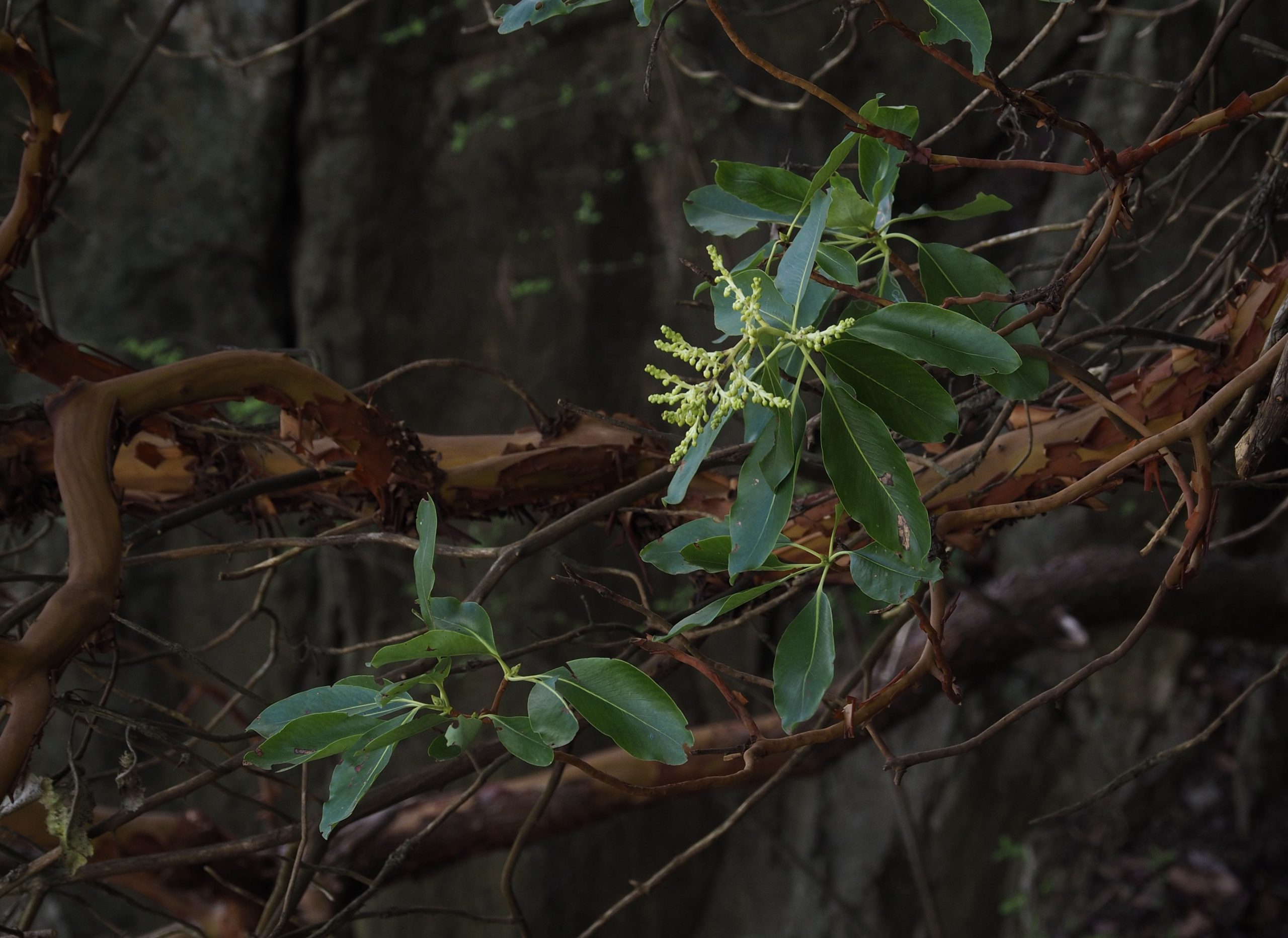
The Pacific rhododendron can be confused with young specimens of the distantly related Pacific madrone (Arbutus menziesii), also called the madrona and arbutus, which shares most of its range and has similarly shaped, whorled leaves on the upper portions of its new growth. However, the Pacific madrone is a true tree that reaches a much greater height with heftier trunks and branches, bears shinier, less pointed leaves with sometimes finely serrate edges, sheds its smooth, chartreuse bark in shaggy, cinnamon shards, and produces branched clusters of small, white, urn-shaped flowers followed by red berries.
Gallery
© 2026 Anthony Colburn. Images may not be used or reproduced in any form without express written consent.